
Quality Assurance
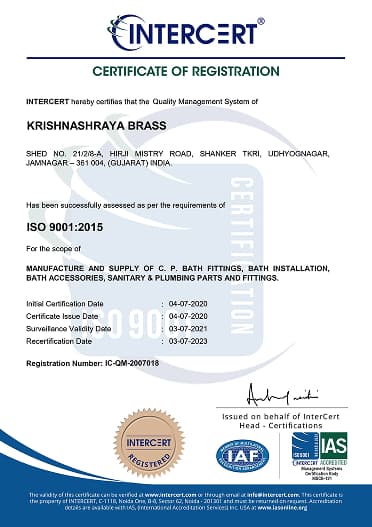
Krishnashraya Brass is a trusted manufacturer committed to complete customer satisfaction, backed by strong industry expertise and goodwill. Established in 2016 as Tavashmi Brass Industries, the company has earned appreciation at the domestic level for its consistent quality and reliable services. Today, operating as Krishnashraya Brass, we have expanded our operations to serve the international market. We strictly follow ISO 9001:2015 Quality Management System (QMS) standards, ensuring superior manufacturing practices, process control, and continuous improvement. Our focus on innovation, quality assurance, and customer-centric solutions makes us a dependable brass components supplier worldwide.
Types of Thread
BSP THREAD
British Standard Pipe (BSP) has been used in plumbing and pipe fittings and It is also known as Whitworth 55°.
There are two types of BSP Thread :
- Parallel threads OR Straight threads : Parallel thread have a constant diameter.
- Taper Thread : Taper thread which diameter increases or decreases along with the length of the thread.
Thread Count (TPI)
Threads Per Inch means the total number of threads per inch are measured along with the length of a fastener. TPI is only used in American fasteners. In smaller fasteners the threads are finer, so the thread count will be higher.
| Size | Pitch | External Thread OD | Internal Thread ID | ||
|---|---|---|---|---|---|
| Inch | TPI | Mm | Inch | Mm | Inch |
| 1/8 | 28 | 9.6 | 0.38 | 8.6 | 0.34 |
| ¼ | 19 | 13 | 0.51 | 11.9 | 0.47 |
| 3/8 | 19 | 16.5 | 0.65 | 15.2 | 0.6 |
| ½ | 14 | 20.8 | 0.82 | 19.1 | 0.75 |
| 5/8 | 14 | 22.8 | 0.9 | 20.8 | 0.82 |
| ¾ | 14 | 26.3 | 1.04 | 24.6 | 0.97 |
| 1 | 11 | 31.1 | 1.3 | 30.7 | 1.21 |
| 1 ¼ | 11 | 41.8 | 1.64 | 39.4 | 1.55 |
| 1 ½ | 11 | 47.7 | 1.88 | 45.5 | 1.79 |
| 2 | 11 | 59.5 | 2.34 | 57.4 | 2.26 |
| 2 ½ | 11 | 75.1 | 2.95 | 72.6 | 2.86 |
| 3 | 11 | 87.9 | 3.46 | 85.4 | 3.3 |
Thread Pitch
Thread Pitch is used in Metric fasteners which are specified with a thread pitch instead of a thread count. The thread pitch is the distance between threads expressed in millimeter. Smaller fasteners have finer thread so that they have lower thread pitch.
FREE CUTTING BRASS ROD
Free Cutting Brass is also known as Leaded Brass which contains 56 to 63% of Copper, 2 to 3.50% Lead and remaining of Zinc. The addition of Lead reduces wear on the cutting tool, and it permits part to be processed rapidly on automatic machines. Good strength and ductility are combined with excellent corrosion resistance. Free Cutting Brass set the standard by which the machinability of other materials is judged. The usage of Free Cutting Brass ensures cost effectiveness via application of close tolerance manufacturing techniques and reducing tooling costs.
| IS 319 | Equivalent Specification | Copper | Lead | Iron | Zink | Other Impurities | Yield Stress | Tensile Strength | Hardness Brinell | Elonga- tion | |
|---|---|---|---|---|---|---|---|---|---|---|---|
| IS 319 GRADE 1 | CZ121 | CW6 14N | 56 to 58% | 2.00 to 3.50% | 0.30% Max | Balance | 0.75% Max | 150 MPa Min. | 380 MPa Min | 90 to 160 HB | 18 Min |
| BS2874 | BS249 | ||||||||||
| IS 319 GRADE 2 | ASTM B16 | UNS C36000 | 60 to 63% | 2.50 to 3.70% | 0.35% Max | Balance | 0.50% Max | 150 MPa Min. | 325 MPa Min. | 90 to 160 HB | 15 Min |
| CuZn36 Pb3 | CW6 03N | ||||||||||
| IS 319 GRADE 3 | ASTM B16 | UNS C36000 | 60 to 63% | 0.50 to 1.50% | 0.20% Max | Balance | 0.50% Max | 150 MPa Min. | 285 MPa Min | 90 to 160 HB | 10 Min |
| CuZn36 Pb3 | CW60 3N | ||||||||||
Inspection & Testing Process
Material Composition Verification
Ensuring the correct material composition is the first step in maintaining quality. Since brass is an alloy with varying ratios of copper and zinc, along with trace elements like lead or tin, even small deviations can affect the component's properties.
- Spectroscopy Analysis: Techniques Like X-ray fluorescence (XRF) and Optical Emission Spectroscopy (OES) are widely used to determine the exact composition of the alloy.
- These tests verify that the brass meets specific requirements for the part's application.
- Chemical Analysis: Manufacturers often conduct chemical testing on incoming raw materials to ensure consistency. This involves checking for impurities and confirming the metal's properties before production.
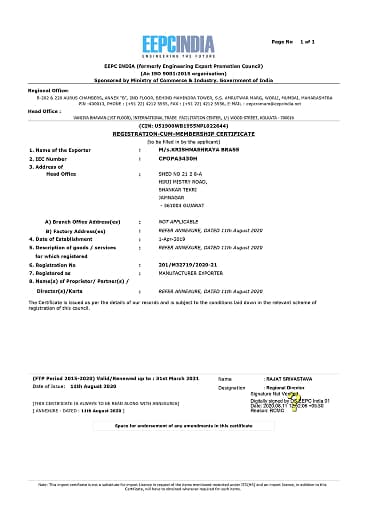
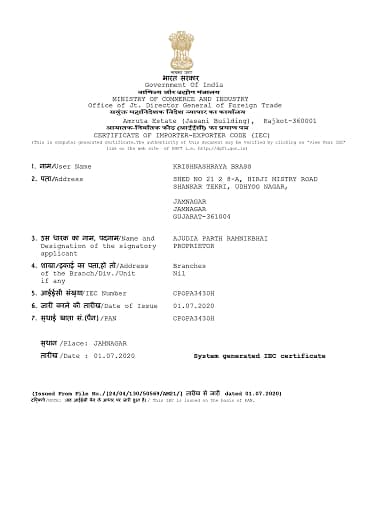
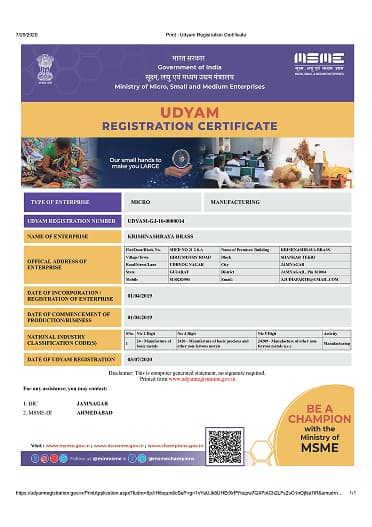
Certificates

Stay Connected with Krishnashraya Brass
Receive important product and manufacturing updates relevant to OEMs, exporters, and industry partners.
We only share essential business updates. No promotional emails.